




Summary
The research presents CDMO and CRO as structurally attractive outsourced life-sciences services markets, but with near-term public-market performance still constrained by uneven biotech funding, longer development timelines and macro uncertainty. The underlying industry thesis remains positive as pharma and biotech companies continue shifting manufacturing and clinical-development activities to external partners, while increasing drug complexity is making specialized capabilities more valuable.
The opportunity is increasingly concentrated in higher-complexity areas rather than commoditized services. For CDMOs, biologics, ADCs, peptides/GLP-1s, oligonucleotides, cell & gene therapy and sterile fill-finish are important growth areas. For CROs, oncology, rare disease, patient recruitment, decentralized trials, data infrastructure and technology-enabled clinical development are becoming increasingly important.
Key Themes
Outsourcing remains the core structural growth driver: Pharma is increasingly externalizing both manufacturing and clinical-development functions to reduce fixed costs, access specialized expertise and accelerate development. CDMOs are increasingly moving toward integrated end-to-end / CRDMO models, while CROs benefit from continued clinical outsourcing penetration.
Complex modalities are creating premium niches: Growth in biologics, ADCs, peptides/GLP-1s, oligonucleotides and cell & gene therapies is increasing demand for technically sophisticated manufacturing capacity, while sterile fill-finish remains an important industry bottleneck.
CRO demand is improving, but funding translates into trials with a lag: Recovering biotech capital formation is supporting more RFP activity, while pharma’s upcoming patent cliff is driving pipeline replenishment through licensing, M&A and accelerated clinical development.
Technology is reshaping CRO economics: Decentralized trials, wearables, EHR integration, automated patient matching and AI are improving recruitment and trial execution. At the same time, AI could pressure traditional billable-service models and increase the strategic value of proprietary datasets and clinical technology platforms.
Capacity quality matters more than capacity alone: CDMO economics are highly sensitive to utilization because of substantial fixed costs. Specialized, well-utilized assets can generate attractive economics, whereas excess or poorly positioned capacity can significantly pressure margins.
Supply-chain localization is becoming strategic: Geopolitical risk, BIOSECURE-related concerns and supply-chain resilience are encouraging China+1 strategies, dual sourcing and U.S./European manufacturing expansion, potentially increasing the strategic value of established Western facilities.
M&A is increasingly a buy-vs-build decision: Given the time required to construct, validate and scale specialized facilities, strategics and PE sponsors are acquiring established manufacturing capacity, technical capabilities, patient-recruitment platforms and specialized CRO assets instead of building organically. The transaction pages show activity across both strategic and sponsor-backed buyers.
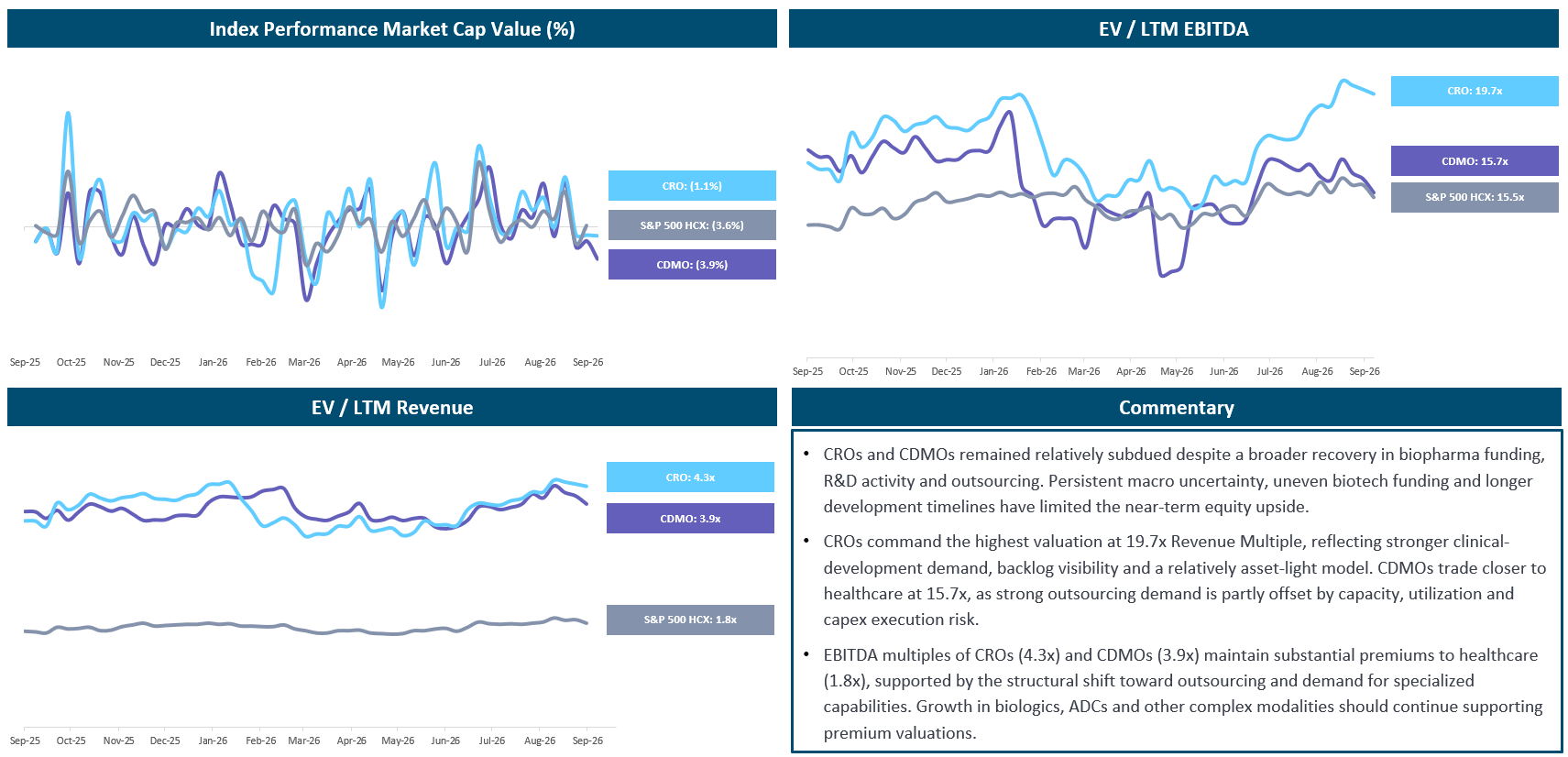
Valuations remain highly differentiated: The public-comps analysis shows median CDMO EV/LTM Revenue of ~3.1x and EV/LTM EBITDA of ~13x, versus approximately 2.1x revenue and 13x EBITDA for CROs. The wide company-level dispersion indicates investors are differentiating strongly based on growth, specialization, margins and asset quality rather than valuing the sectors uniformly.