





Precision Oncology: Commercialization Is Becoming the Differentiator
Precision oncology is moving beyond technical validation toward a more demanding commercial phase. Test quality remains essential, but market value increasingly depends on reimbursement, laboratory efficiency, physician adoption, repeat utilization, and the ability to convert clinical data into durable revenue.
Key Market Themes
Reimbursement sets the commercial ceiling
Coverage, contracted rates, denials, prior authorization, and collection timing ultimately determine realized revenue per test—not the published reimbursement rate alone.
Laboratory execution determines profitability
Sequencing depth, automation, batch density, sample failures, logistics, and fixed-cost absorption determine how much revenue converts into gross profit. Higher testing volume helps, but cannot offset weak reimbursement or costly assays.
Data adds value, but not all pharma revenue is equal
Longitudinal clinical datasets can support high-margin licensing opportunities, while biopharma testing, laboratory services, and project work remain more operationally intensive.
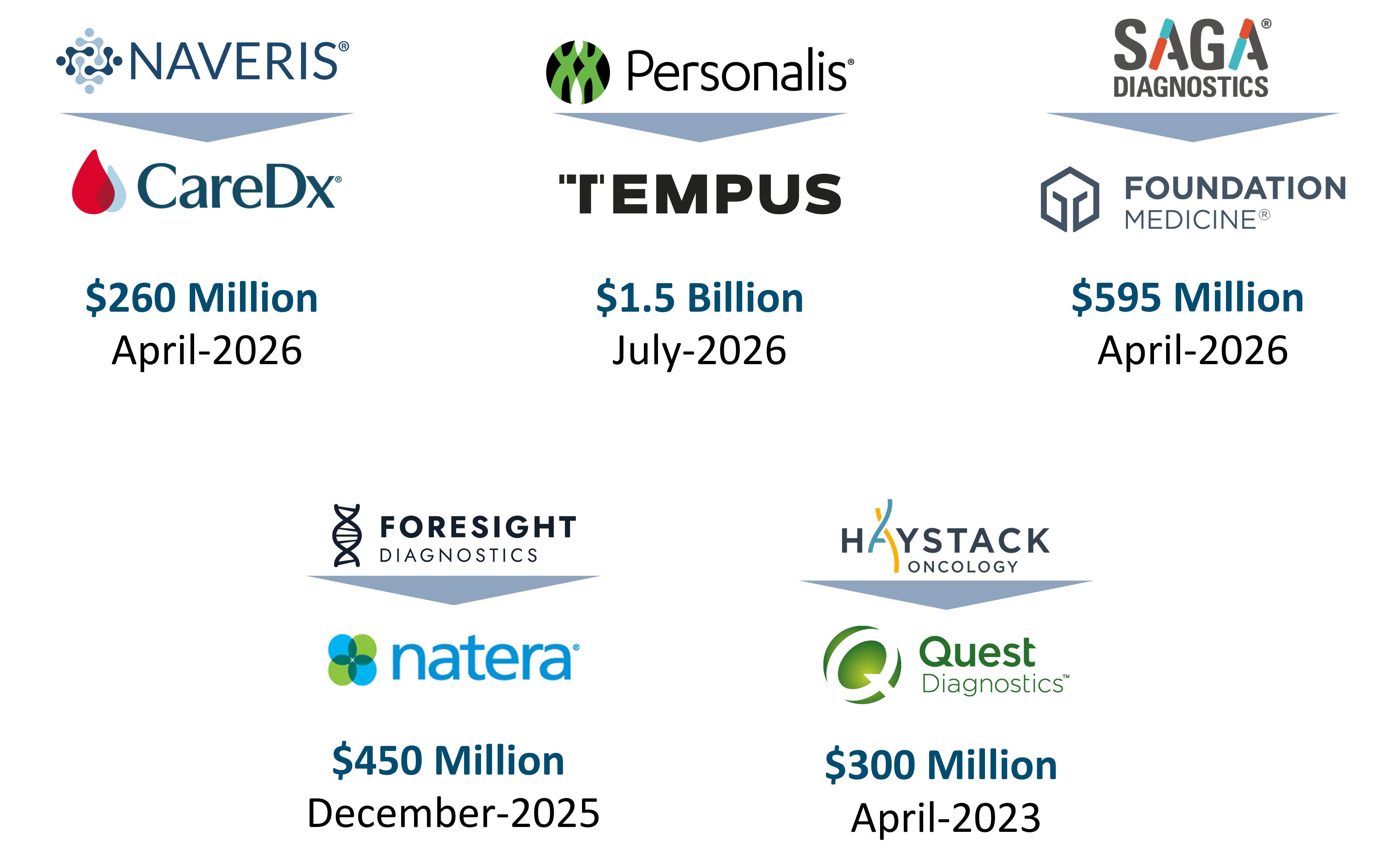
Commercial adoption is becoming an acquisition asset
Clinical evidence, physician relationships, embedded ordering behavior, payer coverage, and longitudinal utilization can materially reduce a buyer’s market-entry time. Strategic value increasingly lies in owning the full commercial infrastructure, not simply the underlying assay.
Commercialization in Different Market Segments
Comprehensive Genomic Profiling
Comprehensive genomic profiling combines broad-panel sequencing, bioinformatics, and tissue or blood processing to guide therapy selection. The market remains dependent on payer coverage and oncology-center adoption, with biopharma partnerships providing an additional data-monetization channel.
Minimal Residual Disease
MRD creates a recurring testing model through baseline assessment, serial surveillance, treatment-response monitoring, and recurrence detection. Growth is being driven by expanding Medicare coverage, broader clinical indications, and increasing physician adoption of longitudinal monitoring.
Multi-Cancer Early Detection
MCED targets asymptomatic populations through physician-directed and cash-pay screening, creating one of the largest potential markets in precision oncology. Commercial adoption, however, remains constrained by the absence of broad reimbursement and the need for stronger regulatory and clinical-outcomes evidence.
M&As Covered with Commercialization as Primary Catalyst
Please open the full report below: