



Healthcare Wearables Market Research

From Fitness Devices to Clinical Platforms
Healthcare wearables are moving beyond activity tracking toward continuous, AI-enabled health monitoring. Growth is being driven by chronic disease, remote patient monitoring, better sensors, reimbursement, and demand for more proactive care. The most attractive platforms increasingly combine hardware with recurring revenue, clinical evidence, workflow integration, and longitudinal patient data.
Market Summary
From episodic readings to continuous health intelligence: Wearables are shifting from isolated measurements to platforms that track physiological changes, establish personal baselines, and flag early deterioration; moving closer to a personal “Health OS.”
AI is moving closer to the sensor: AI increasingly filters noise, interprets biometric data, and automates reporting. The highest-value applications turn raw signals into clear clinical actions rather than more alerts or dashboards.
The business model is moving beyond hardware: Value is increasingly generated through consumables, subscriptions, monitoring services, analytics, and data partnerships. The strongest platforms pair recurring revenue with deep patient or provider workflow integration.
Consumer wearables are both funnels and substitutes: Smartwatches and rings can prompt medical evaluation, but improving accuracy may also replace some low-acuity monitoring. Clinical-grade devices remain essential for validated diagnosis and treatment decisions.
Clinical integration is the real competitive advantage: Accurate devices can still fail if they create workflow burden. Adoption depends on seamless integration with EHRs, care teams, reimbursement processes, and established clinical pathways.
Evidence and reimbursement separate healthcare from wellness: Clinical validation, physician adoption, recurring consumables, and reimbursement support stronger valuations. Consumer devices can scale through brand, but durable healthcare platforms need a clear clinical and economic case.
Strategic buyers are acquiring capabilities: Transactions increasingly provide access to sensors, AI, longitudinal data, RPM infrastructure, clinical distribution, and consumer engagement—especially platforms connecting the patient, home, and care workflow.
Wearable Market Map
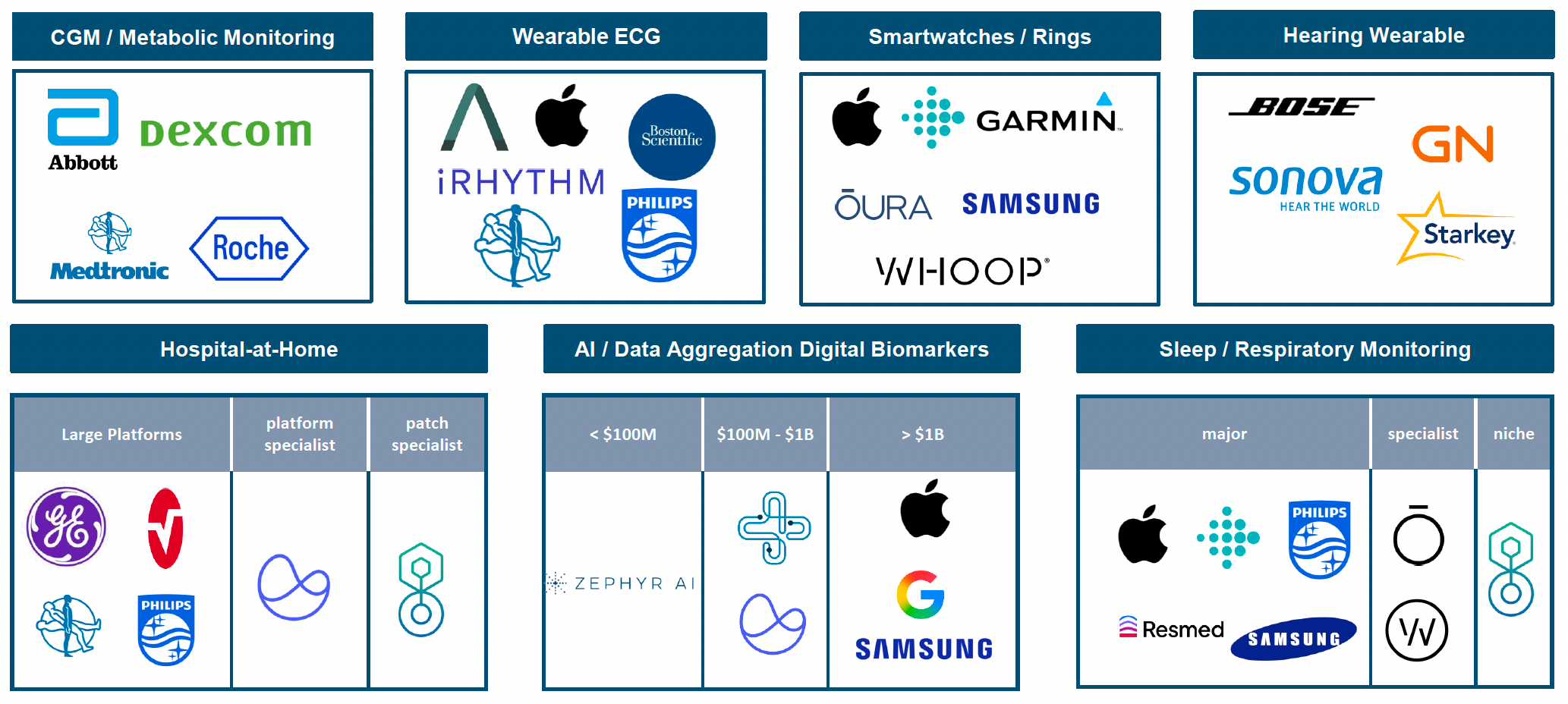
Four Core Wearable Segments
CGM and Metabolic Monitoring
CGM is evolving from a diabetes-management device into a broader metabolic-health platform. Growth is increasingly coming from non-insulin Type 2 diabetes, prediabetes, and OTC wellness. The next technology frontier is multi-analyte sensing and tighter integration with coaching, insulin delivery, and digital care. Its recurring sensor model, reimbursement support, and expanding user base make it one of the most financeable wearable categories.
Wearable ECG / Cardiac Monitoring
Wearable ECG has moved beyond simple rhythm capture toward integrated diagnostic services combining patches, AI interpretation, clinical review, and EHR connectivity. Longer monitoring periods, earlier detection, and multi-parameter sensing are expanding its clinical role, while automation can improve scalability and margins. Established reimbursement and strong workflow integration create a clear path to recurring revenue and strategic investment.
Smartwatches and Smart Rings
Smartwatches and rings are shifting from fitness tracking toward continuous wellness and early health screening across sleep, cardiovascular health, recovery, and women’s health. Future growth will depend on better sensors, stronger clinical partnerships, and turning large biometric datasets into useful, trusted insights. The most compelling funding stories combine hardware scale with subscriptions, retention, and a credible healthcare use case.
Specialty Clinical Patches
Clinical patches are becoming a practical bridge between hospital monitoring and care at home. Multi-vital sensing, cloud analytics, and AI-enabled alerts are expanding their use across RPM, post-acute care, respiratory monitoring, and hospital-at-home programs. Companies that pair reliable wearability with recurring patch revenue, enterprise contracts, and reimbursement-backed services are best positioned to attract growth capital.
Please open the full report below: