



Genomic Profiling Market Research

Market Summary
From reactive treatment to personalized and preventive care: Genomic testing is increasingly supporting earlier diagnosis, risk stratification, therapy selection, and disease monitoring across oncology, reproductive health, neurology, cardiovascular disease, and rare disease.
Technology is making genomic testing more scalable: Declining sequencing costs, broader adoption of whole-exome and whole-genome sequencing, AI-driven variant interpretation, and multi-omics are improving diagnostic accuracy while reducing turnaround times.
Clinical guidelines and reimbursement are the primary adoption catalysts: Professional society recommendations increasingly establish genomic testing as part of standard care, while Medicare, Medicaid, MolDX, and commercial payer coverage determine how quickly testing volumes can scale.
Oncology remains the largest and most developed market: Precision oncology benefits from expanding targeted therapies, companion diagnostics, liquid biopsy, and minimal residual disease monitoring. However, broad genomic profiling is still used in only approximately 25% of metastatic cancer patients, leaving significant room for adoption.
The business model is shifting toward longitudinal testing: Value increasingly comes from repeat monitoring, recurring testing volumes, biopharma partnerships, and clinical data monetization rather than one-time sequencing. MRD is especially attractive because patients may be tested repeatedly throughout treatment and surveillance.
Proprietary data is becoming a competitive moat: Large clinico-genomic datasets support AI-enabled diagnostics, real-world evidence, biomarker discovery, clinical trial recruitment, and pharmaceutical partnerships. Platforms that continuously expand their data assets can strengthen both clinical utility and strategic value.
Clinical genomics is expanding into preventive care: Reproductive testing, newborn screening, inherited disease testing, and population genomics are moving genetic testing earlier in the patient journey, potentially identifying disease risk before symptoms emerge.
Strategic buyers are acquiring end-to-end capabilities: M&A activity increasingly targets multi-omics, liquid biopsy, AI interpretation, workflow software, and recurring diagnostic platforms. Buyers are seeking to connect sequencing, bioinformatics, pathology, and companion diagnostics within integrated precision medicine ecosystems.
Genomics Market Map
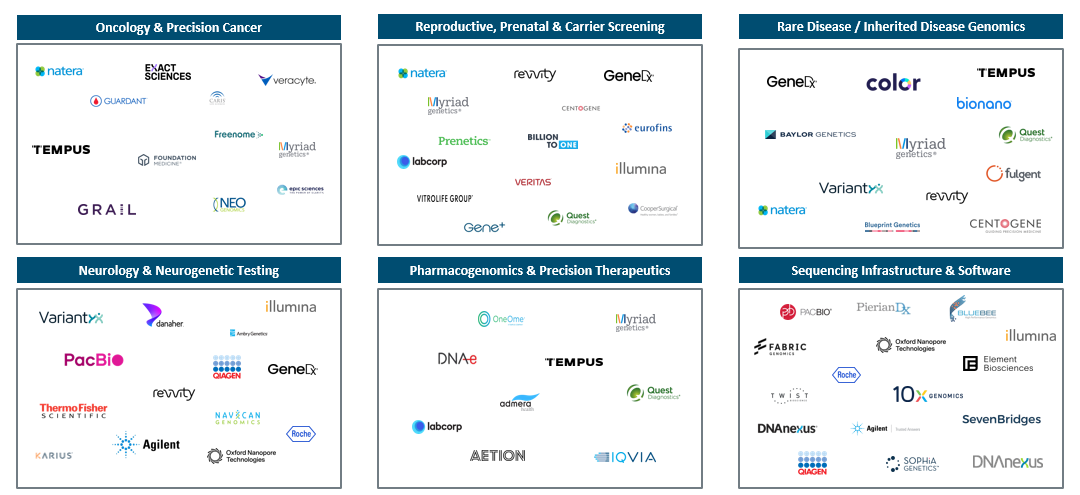
The market spans oncology and precision cancer, reproductive and prenatal screening, rare and inherited disease genomics, neurology and neurogenetic testing, pharmacogenomics, precision therapeutics, and sequencing infrastructure and software. The market map on page five highlights a mix of clinical laboratories, sequencing providers, diagnostic platforms, and software-enabled interpretation companies
Four Core Genomics Segments
Oncology & Precision Cancer Genomics
Precision oncology is the largest clinical genomics market, supported by tissue-based sequencing, liquid biopsy, companion diagnostics, hereditary cancer testing, MRD, and multi-cancer early detection. The global cancer genomics market is estimated at approximately $20 billion in 2025 and is projected to reach approximately $38 billion by 2029. Growth is increasingly tied to longitudinal monitoring, reimbursement expansion, and the continued development of biomarker-driven therapies.
The next technology frontier includes multi-omics integration, earlier-stage cancer detection, and highly sensitive MRD testing. MRD can identify molecular recurrence before clinical evidence and remains significantly underpenetrated, creating one of the sector’s most attractive recurring-revenue opportunities.
Reproductive, Rare Disease & Emerging Clinical Applications
Reproductive and rare disease genomics are moving testing earlier in the patient journey through NIPT, carrier screening, IVF-related testing, rapid whole-genome sequencing, newborn screening, and population genomics. These applications support the broader transition from reactive diagnosis toward predictive and preventive healthcare.
The U.S. NIPT market is valued at approximately $1.8 billion, with penetration expected to increase from 53% to 85% by 2032. Testing volumes are supported by physician referrals, centralized laboratory infrastructure, professional guidelines, and expanding payer coverage.
Neurology & Neurogenetic Testing
Neurogenetics is becoming increasingly important for diagnosing rare neurological disorders, stratifying patients, and identifying candidates for gene therapies and RNA-based treatments. Whole-exome and whole-genome sequencing are gradually replacing narrower panels as sequencing costs decline and diagnostic capabilities improve.
Clinical guideline expansion is creating a clearer adoption pathway. The report highlights first-line WES/WGS recommendations in pediatric developmental disorders and expanding Medicaid coverage for outpatient and rapid inpatient genome sequencing. Long-term growth will also be supported by Alzheimer’s biomarkers and precision neurology therapeutics.
Cardiovascular & Inherited Disease Genomics
Cardiovascular genomics is shifting care from late-stage disease management toward earlier identification of inherited risk across cardiomyopathies, arrhythmias, familial hypercholesterolemia, aortopathies, and sudden cardiac death. The segment remains underpenetrated, with only approximately 9% to 11% of cardiomyopathy patients genetically diagnosed.
The segment’s distinctive growth engine is cascade testing. Once a pathogenic variant is identified in one patient, first-degree relatives can also be tested, creating an expanding referral network. Polygenic risk scores, guideline expansion, and precision therapeutics could further increase the strategic value of cardiovascular genomic data.
Please open the full report below:
