

Executive Summary
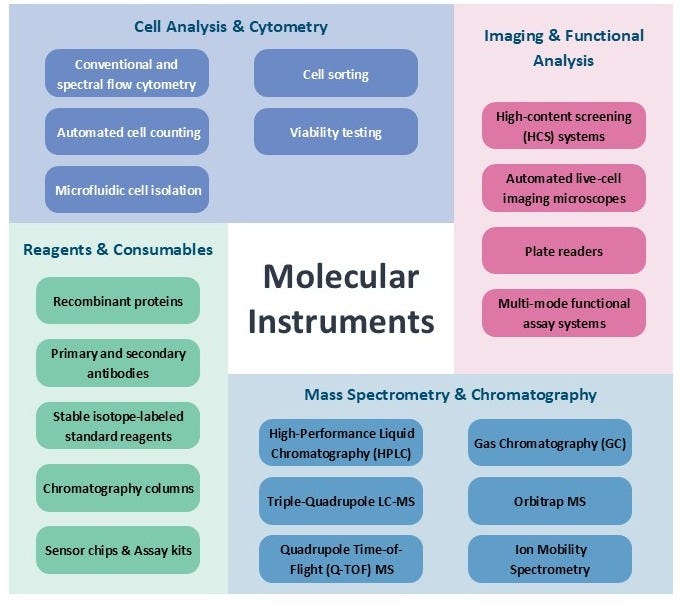
Market Scope
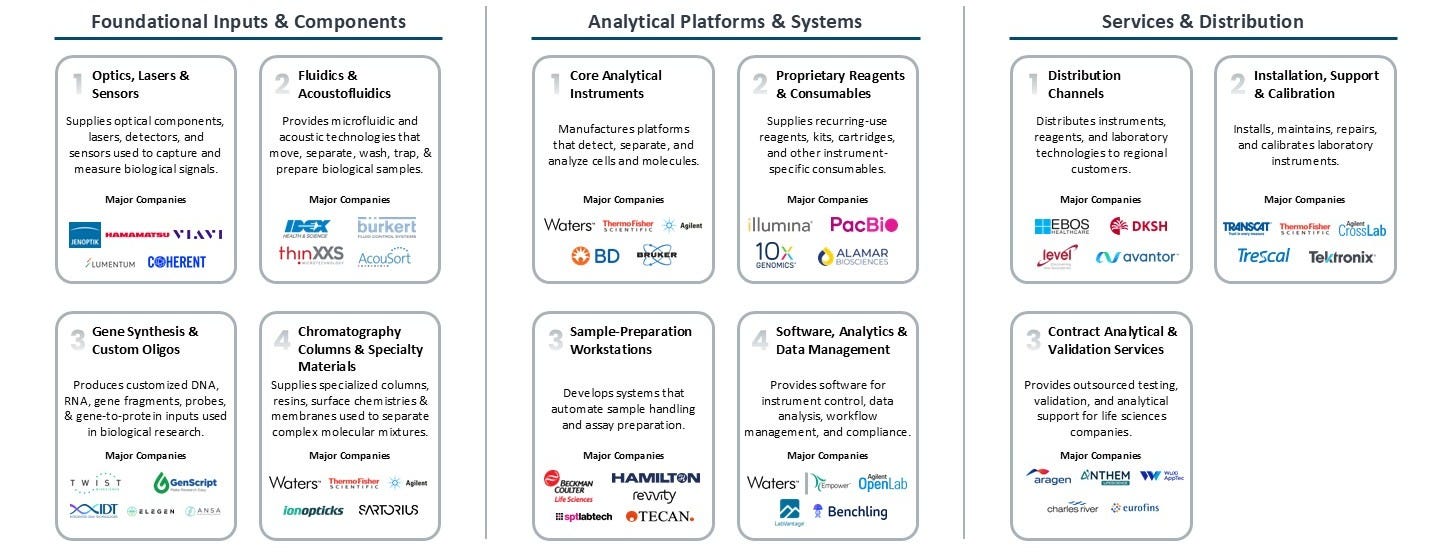
Different parts of the value chain offer different investment profiles: Foundational inputs, analytical platforms, and services each vary in growth, margins, defensibility, capital intensity, and consolidation potential.
Foundational inputs benefit from strong technical lock-in: Designed-in OEM components, chromatography columns, and specialty materials can generate durable revenue because switching often requires costly engineering or regulatory re-validation.
Gene synthesis and microfluidics offer higher growth, but also higher risk: Demand is being driven by AI-enabled drug discovery, synthetic biology, automation, and more complex biological workflows, offset by greater technology, scaling, and capital requirements.
Analytical platforms have the strongest recurring-revenue economics: Instrument placements drive proprietary consumables, reagents, software, and service revenue, creating attractive razor-and-blade models. NovaSeq X generates about $1.3M of annual consumables pull-through per instrument, while diversified platforms such as Danaher derive roughly 80% of revenue from recurring sources.
Services and distribution offer defensive cash flows: Regulatory validation, maintenance, calibration, long-term customer relationships, and fragmented markets support retention and make the segment attractive for PE-led consolidation and buy-and-build strategies.
Investor fit differs by segment: Growth equity is better suited to higher-growth inputs and components, strategics tend to favor differentiated analytical platforms, and private equity is generally better aligned with services and distribution businesses offering recurring cash flow and consolidation potential.
Molecular Instruments Value Chain
Customer Journey & Commercial Bottlenecks
Adoption of molecular and biophysical analysis tools is rarely a simple equipment purchase. Sales cycles are typically long, technically intensive, and dependent on scientific validation, workflow integration, and budget availability.
Scientific validation comes first: New platforms generally require technical evaluation, pilot studies, KOL endorsement, and peer validation before customers commit. Vendors often need to support demonstrations, academic placements, and application development to prove technical fit.
Procurement can materially extend the sales cycle: High instrument prices, constrained CapEx budgets, and grant timing can delay purchases. Reagent-rental, leasing, and other OpEx-oriented models can improve adoption but shift more capital burden onto the vendor.
Workflow integration is a major conversion risk: Instruments must integrate with sample-preparation processes, software, LIMS/LIS, and laboratory data infrastructure. Site-readiness issues, proprietary data formats, and weak interoperability can delay deployment and prevent pilots from converting into commercial use.
Regulated adoption requires substantial validation: Clinical and regulated laboratories may need IQ/OQ/PQ, method validation, accreditation, SOP development, and staff training. These processes can take 18–24 months, delaying commercial ramp-up.
The real economics begin after placement: Instrument sales only become attractive recurring-revenue businesses when customers generate sufficient utilization and consumables pull-through. Service revenue can lag installation by 12–18 months, making post-installation adoption and usage critical to lifetime customer value.
Go-To-Market Strategies
Life sciences tools vendors typically win through technical validation, workflow integration, flexible purchasing models, and recurring installed-base monetization rather than instrument sales alone.
Hybrid direct and distributor models broaden reach: Vendors use direct scientific sales for complex platforms in core markets while leveraging distributors and digital channels to expand coverage across fragmented geographies.
KOL seeding supports early adoption: New technologies are often placed with leading academic centers and key opinion leaders to generate validation, publications, and reference customers before broader commercial rollout.
CapEx-light models reduce purchasing friction: Reagent-rental, leasing, and other OpEx-based structures lower upfront costs while creating multi-year consumables commitments and improving customer adoption.
Trials and application support improve conversion: Demonstrations, pilot programs, and dedicated application scientists help customers validate technical performance and workflow fit before committing capital.
Commercial selling is increasingly ROI-driven: Purchasing decisions are shifting toward cost per sample, labor savings, productivity, uptime, and total cost of ownership rather than instrument price alone.
Installed-base monetization drives recurring revenue: Once instruments are placed, vendors expand revenue through proprietary consumables, software, maintenance, calibration, upgrades, and service contracts.
Technology Landscape & Commercialization
Analytical platforms are becoming more integrated: Instruments are moving toward higher sensitivity, greater multiplexing, automation, and tighter integration with software, bioinformatics, and AI.
Recurring revenue drives the strongest economics: Proprietary reagents, consumables, software, and services create attractive razor-and-blade models once instruments are embedded in customer workflows.
Installed-base monetization is critical: The value of a platform increasingly depends on utilization and recurring pull-through rather than instrument placements alone.
Distribution is becoming more technical: Regional partners are expanding beyond product delivery into installation, training, calibration, maintenance, and regulatory support.
Services are becoming more strategic: Remote diagnostics, predictive maintenance, validation, and multi-vendor support create recurring revenue and deeper customer relationships.
Contract analytical services benefit from complexity: Growth in ADCs, oligonucleotides, peptides, and cell and gene therapies is increasing demand for outsourced, high-throughput analytical and validation capabilities.
Please see the detailed report below: