



The MedTech market is entering a more active but increasingly selective phase. Stable procedure volumes, attractive acquisition valuations, improving financing conditions, and continued innovation across AI, robotics, electrophysiology, monitoring, and minimally invasive care are supporting renewed strategic activity. At the same time, investors remain focused on clinically differentiated platforms with strong reimbursement pathways, scalable commercialization models, and clear evidence of capital efficiency.
Market Summary
Procedure volumes remain a resilient industry foundation: Demand for elective and high-acuity procedures continues to support MedTech revenue growth despite healthcare policy uncertainty, constrained hospital budgets, and broader macroeconomic pressure. Aging populations, chronic disease prevalence, and sustained technology investment reinforce the industry’s long-term outlook.
Thanks for reading! Subscribe for free to receive new posts and support my work.
Subscribe
M&A is accelerating as valuations favor buyers: Strategic tuck-ins, portfolio optimization, and private equity carve-outs are increasing as MedTech assets trade near the lower end of historical valuation ranges. The report notes that 2025 MedTech deal value reached approximately $73 billion, compared with approximately $41 billion in 2024.
Capital is concentrating in larger, de-risked platforms: Later-stage companies with strong clinical evidence and established commercialization pathways continue to attract substantial financings. Early-stage rounds remain smaller and more milestone-driven, requiring earlier validation of clinical data, reimbursement, and market access.
AI is becoming embedded in clinical workflows: Artificial intelligence is increasingly integrated into imaging, diagnostics, procedural planning, and physician workflows. The most attractive applications improve diagnostic accuracy, procedural precision, clinician productivity, or hospital operating efficiency rather than functioning as standalone software tools.
Care continues to migrate toward outpatient settings: The movement of elective procedures into ambulatory surgery centers is increasing demand for minimally invasive, workflow-efficient, and cost-effective technologies that can reduce procedure time and simplify care delivery.
Robotics is expanding beyond traditional surgery: Robotic-assisted technologies are moving into catheter-based cardiovascular and neurovascular procedures. Growth is being supported by demand for greater precision, consistent navigation, reduced physician radiation exposure, and improved procedural ergonomics.
Electrophysiology remains a major innovation cycle: Pulsed field ablation is accelerating electrophysiology procedure growth and supporting adoption of premium catheter platforms. Rising atrial fibrillation prevalence and procedure volumes continue to attract strategic and venture investment.
Regulation and reimbursement remain central to adoption: Coding requirements, payer policies, and evolving regulatory frameworks continue to determine commercialization strategies and hospital purchasing decisions. Investors increasingly prioritize companies with defined reimbursement pathways and demonstrated clinical differentiation.
MedTech Market Activity
The July report highlights continued transaction activity across cardiovascular intervention, pain management, surgical products, wound care, urology, and regenerative medicine. Strategic buyers are acquiring differentiated procedural capabilities, while private investors are backing later-stage companies in regenerative implants, radiation therapy, wearable cardiovascular monitoring, stroke treatment, and biomaterials.
The transaction overview on page six also illustrates the breadth of recent buyer interest, including neurovascular devices, remote patient monitoring, pulse oximetry, intravascular imaging, vascular access, radiation therapy, spine, respiratory monitoring, and women’s health.
Four Core MedTech Themes
Cardiovascular Intervention and Electrophysiology
Cardiovascular MedTech remains one of the industry’s most active innovation areas. Investment is flowing toward electrophysiology, structural heart, vascular intervention, stroke treatment, robotic catheter navigation, and advanced imaging. Pulsed field ablation is creating a significant technology upgrade cycle, while minimally invasive platforms continue to benefit from procedure growth and demand for improved clinical precision.
The report’s Stereotaxis–Robocath case study demonstrates the strategic logic of platform consolidation. Stereotaxis acquired Robocath to combine robotic magnetic navigation with robotic catheter manipulation, creating a broader platform spanning electrophysiology, coronary intervention, and endovascular procedures. The transaction included $20 million upfront and up to $25 million in milestone payments.
The combination also addresses a recurring challenge for emerging device companies: differentiated technology may not be sufficient without global distribution, physician training, clinical support, and the commercial infrastructure required for capital-equipment sales.
Surgical Robotics and Minimally Invasive Care
Robotic-assisted surgery continues to expand across both established and emerging procedure categories. The market is moving beyond large general-surgery platforms toward specialized systems designed for cardiovascular, neurovascular, urologic, orthopedic, and image-guided procedures.
The investment case increasingly depends on more than technical performance. Successful platforms must demonstrate improved procedural consistency, reduced physician burden, efficient hospital workflows, and a credible pathway to broad clinical adoption. Robotics businesses also require substantial commercial infrastructure because training, service, clinical support, and long sales cycles are central to adoption.
AI-Enabled Imaging, Monitoring, and Clinical Workflows
AI-enabled imaging and diagnostic technologies are improving disease detection, image interpretation, procedural planning, and clinical workflow efficiency. Imaging and neurology have become particularly attractive early-stage financing categories, supported by interest in AI-powered diagnostics, brain-computer interfaces, neuromodulation, and image-guided intervention.
Non-invasive monitoring also remains resilient. The report highlights continued strategic activity in remote patient monitoring, pulse oximetry, wearable blood-pressure monitoring, and connected care workflows. The most compelling platforms combine differentiated hardware with data integration, recurring monitoring relationships, and clear clinical use cases.
Capital Markets and MedTech Valuations
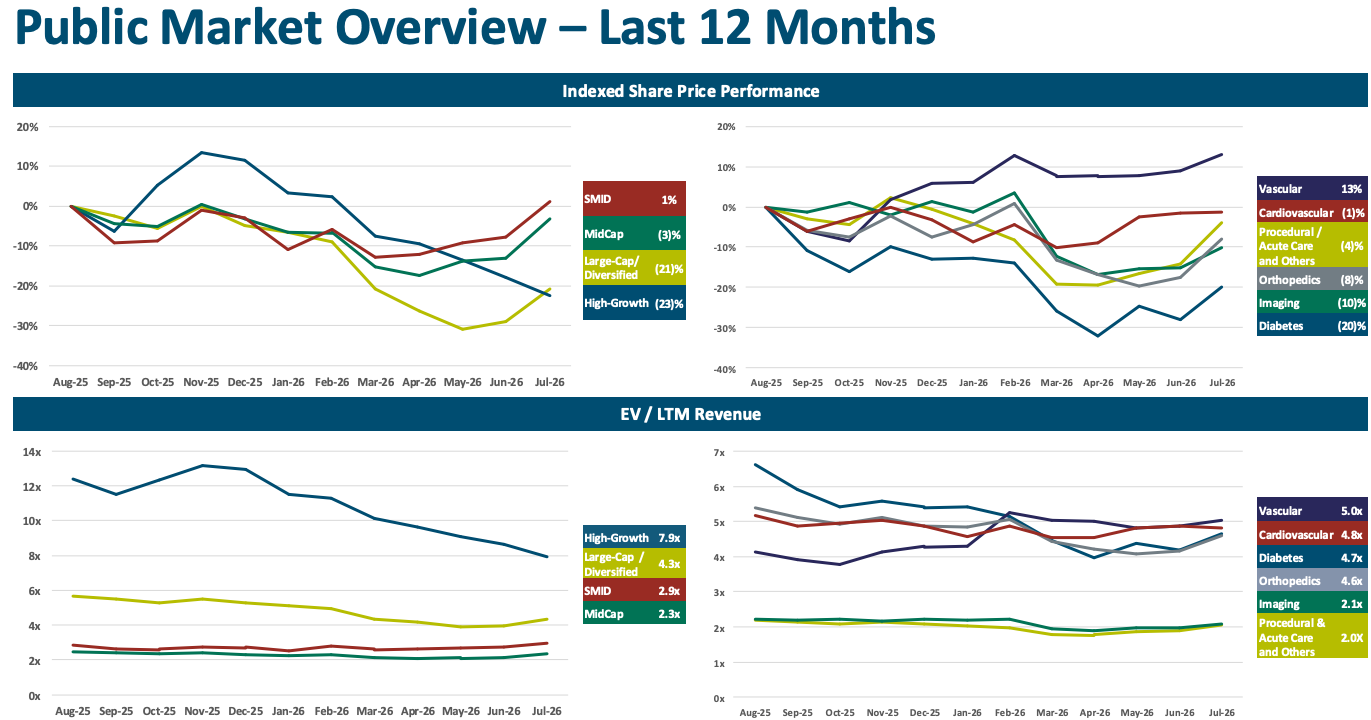
Public-market performance remains highly polarized. As of July 30, 2026, high-growth MedTech companies traded at approximately 7.9x enterprise value to last-twelve-month revenue, compared with 4.3x for large-cap diversified companies, 2.9x for SMID-cap companies, and 2.3x for mid-cap companies.
Subsector valuations also vary meaningfully. Vascular and cardiovascular companies traded near 5.0x and 4.8x revenue, respectively, while imaging and procedural or acute-care companies traded closer to 2.1x and 2.0x. This dispersion reflects differences in expected growth, clinical differentiation, competitive intensity, and profitability.
The private financing market is showing signs of recovery, but capital remains selective. First-financing investment reached $801 million across 61 deals during the first half of 2026, putting the market on pace to exceed $1.6 billion for the year. Investors are writing larger initial checks for well-capitalized platforms capable of reaching meaningful clinical and commercial milestones before requiring additional financing.
Please open the full report below: