

ŌURA at a Glance
ŌURA is a consumer wearable company headquartered in Oulu, Finland and San Francisco, California. The company has evolved from a sleep- and recovery-focused wearable into a broader health platform spanning wellness, women’s health, metabolic health, performance, and preventive care.
Business Model
ŌURA combines premium smart-ring hardware with a recurring membership model. The ring serves as the entry point into the ecosystem, while the membership provides personalized analytics, longitudinal health insights, and advanced app features.
Products are distributed through direct-to-consumer, retail, and enterprise channels. Manufacturing is outsourced to third-party partners, allowing ŌURA to focus on product development, software, data, and brand.
Products
ŌURA’s core product is the Oura Ring, designed for continuous tracking of sleep, recovery, activity, stress, cardiovascular signals, and women’s health metrics.
The hardware is supported by Oura Membership, which monetizes the installed base through recurring subscription revenue and deeper engagement with health insights. The company also offers accessories such as its portable charging case.
Customer Base
ŌURA serves a broad and increasingly diversified customer base across:
Health & wellness consumers focused on sleep, activity, stress, and preventive health
Women’s health users tracking fertility, pregnancy, and menopause
Athletes and performance users focused on recovery and training readiness
Employers and enterprises using the platform for workforce wellness and fatigue monitoring
Metabolic and weight-management users focused on glucose, nutrition, and GLP-1 support
Military and government customers focused on readiness and recovery
Healthcare and payer customers using wearables for preventive health, chronic care, and population-health programs
ŌURA’s Journey to IPO
ŌURA’s IPO story is the transition from a smart-ring hardware company into a scaled, recurring-revenue health platform, with growth increasingly driven by membership, data, and broader healthcare applications.
2013–2015: Technology Foundation
ŌURA launched its first finger-based smart ring around sleep and recovery, initially targeting biohackers and early wellness adopters through Kickstarter and direct-to-consumer sales.
2018: Early Market Validation
Ring Gen 2 improved comfort and design, helping ŌURA broaden its positioning from technology enthusiasts toward the mainstream wellness market.
2020: Brand and Clinical Credibility
ŌURA used continuous biometric monitoring and partnerships with the NBA/WNBA to strengthen scientific, performance, and mainstream credibility. By this stage, the company had sold approximately 150,000 rings.
2021–2022: Recurring Revenue Inflection
Ring Gen 3 added continuous heart rate, SpO₂, and women’s health capabilities, expanding ŌURA beyond sleep into 24/7 health monitoring. The company also scaled its membership model, reaching 1 million cumulative rings sold by 2022.
2023–2024: Platform Expansion
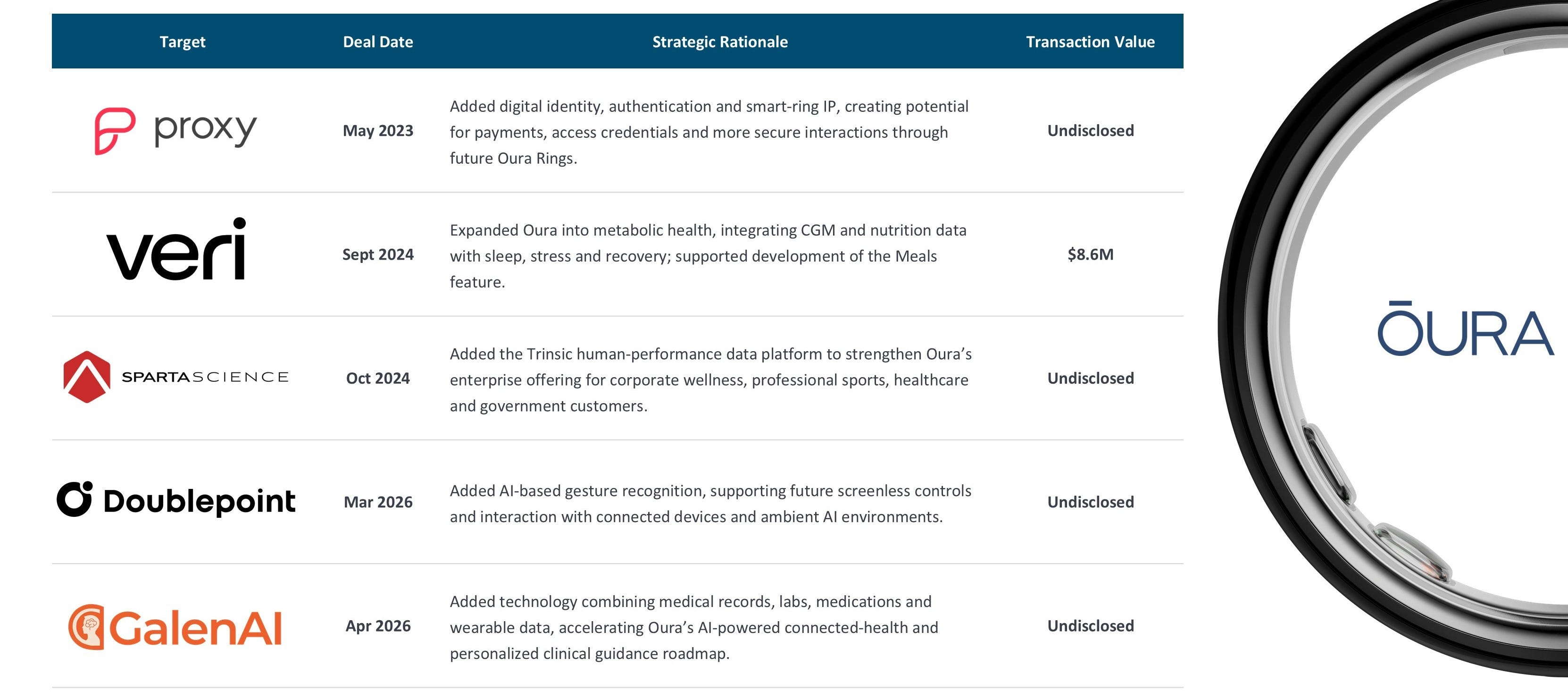
Ring Gen 4 improved sensing accuracy and comfort, while acquisitions and partnerships expanded ŌURA into metabolic health, performance, and enterprise applications. FY2024 revenue reached approximately $406M, with the company valued at $5.2B.
2024–2025: Building the Health Ecosystem
ŌURA broadened the platform into preventive, women’s, and metabolic health, combining wearable data with glucose, lifestyle, and AI-driven insights. FY2025 revenue reached approximately $907M, while its Series E valued the company at $11B.
2026: IPO Scale
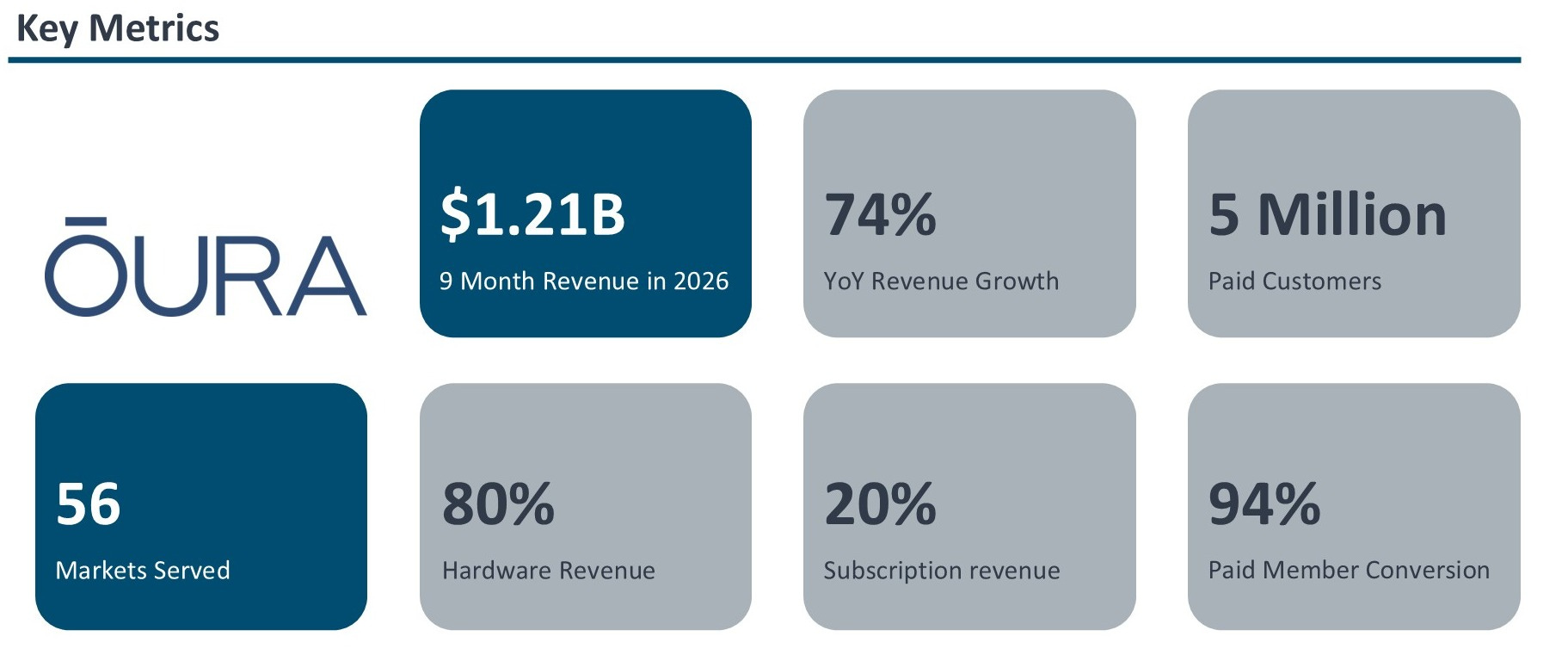
With Ring Gen 5, ŌURA expanded further into AI-enabled and clinically oriented health insights. For the nine months ended June 2026, revenue reached approximately $1.21B, alongside 5 million paid subscribers and 87% retention.
ŌURA’s Acquisitions for Strategic Value
Go-To-Market Strategy
ŌURA uses one core platform across multiple customer segments, but changes the value proposition by use case.
Consumers: ŌURA combines DTC, retail, and word-of-mouth to drive adoption while keeping the membership relationship direct.
Women’s Health: ŌURA builds engagement across fertility, pregnancy, postpartum, and menopause.
Metabolic Health: ŌURA combines glucose, nutrition, sleep, stress, and activity data, supported by partnerships such as Dexcom.
Athletes: ŌURA uses elite-sports adoption to validate performance and strengthen brand credibility.
Employers: ŌURA sells through B2B2C wellness programs while maintaining individual memberships.
Military & Government: ŌURA positions the platform around readiness, fatigue, recovery, and workforce resilience.
Healthcare & Payers: ŌURA uses health-plan partnerships to subsidize access and expand into healthcare-funded distribution.
Summary
Oura has evolved from a niche sleep-tracking ring into a scaled health-intelligence platform, combining premium hardware, recurring membership revenue, omnichannel distribution and increasingly specialized health applications. Its growth has been supported by targeted M&A and partnerships that expanded the platform into women’s health, metabolic health, enterprise, sports and healthcare, culminating in an IPO filing after reaching $1.21B of revenue, 5M paid members and 3.1M rings sold in 9M FY2026.

Please see the detailed report below: