




Point-of-care diagnostics (POC) is evolving from a collection of standalone rapid tests into a broader ecosystem of connected, near-patient diagnostic platforms. The global POC market is expected to grow from approximately $29.3 billion in 2025 to $67.1 billion by 2030, supported by increasing demand for faster clinical decisions, decentralized healthcare delivery, and more sophisticated molecular testing.
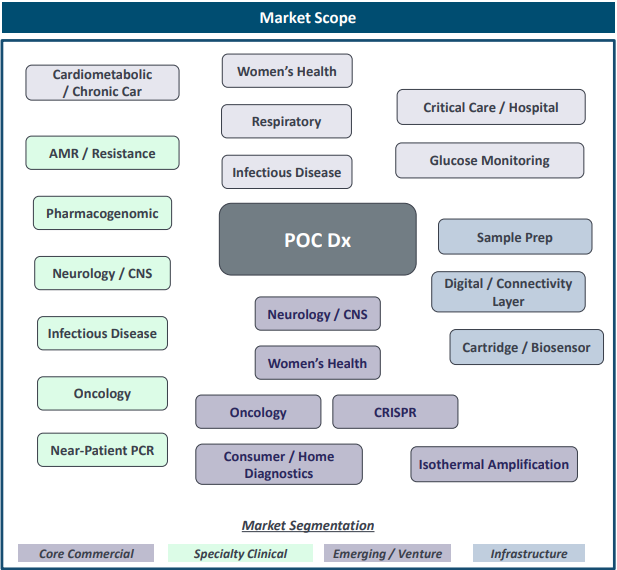
A major driver of this transition is the shift from traditional antigen and lateral-flow testing toward multiplex PCR, isothermal amplification, microfluidics, biosensors, and sample-to-answer platforms. Molecular POC is emerging as one of the fastest-growing areas of the market, particularly across infectious disease, where rapid results can directly influence treatment and antimicrobial stewardship.
The commercial model is changing as well. The most attractive platforms increasingly use analyzers as the gateway to recurring cartridge, reagent, and consumable revenue. As a result, value creation depends less on the number of instruments placed and more on utilization, assay-menu breadth, and consumable pull-through. Connectivity is becoming another important differentiator as hospitals demand seamless LIS/EHR integration, remote quality control, and centralized device management.
From an investment perspective, opportunities extend well beyond mature POC platforms. Specialty diagnostics, emerging at-home testing, microfluidics, biosensors, and diagnostic middleware are creating adjacent opportunities across the value chain. The companies best positioned to capture long-term value will combine rapid and clinically actionable testing with recurring economics, workflow integration, reimbursement visibility, and scalable distribution.
Point-of-care diagnostics is therefore becoming less about simply performing a test outside the central laboratory and more about building an integrated diagnostic infrastructure around the patient.